Find the real middle of your Pokémon card’s sold prices
Paste completed sale prices for the same card and you get the median, the range and the sales worth checking. Free, no account and no invented prices.
Compare sales that are genuinely comparable
Paste at least three sold prices. The result separates the median, the mean, the range and any possible outliers.
Calculated on your device. Your prices never leave it. Sources observed on 8 September 2026; always check the original listings.
Why one sale is not enough to price a card
A misidentified card, a lot or included postage can drag the average a long way. Comparing several sales from the same group makes the spread visible before you decide what to ask or what to pay.
Method, sources and limitations
The prices are sorted from lowest to highest.
splits the sample in two: half the sales are below it, half above.
adds up every price and divides by the number of sales.
runs from the first quartile (Q1) to the third quartile (Q3).
when it sits more than 1.5 × the interquartile range (Q3 − Q1) below Q1 or above Q3. It stays included: the flag asks for a check, not a deletion.
The Cardmarket price guide separates the average sell price, the trend price and different sale periods. French tools such as PokeValue and Upcards also rely on completed sales. These sources, observed on 8 September 2026, establish the need to compare like with like; no external price is imported. Reviewed quarterly.
The result is neither an appraisal nor a promise of sale. It depends entirely on the listings you select and on whether they are genuinely the same card.
What the result includes
The median in euros, with the number of sales it is based on; the mean; the lowest and highest observed price; and the middle half of the sample, from Q1 to Q3.
Any sale outside the interquartile bounds is listed as worth checking but stays in every figure. Between 3 and 50 prices are accepted, from €0.01 to €100,000, one per line. A shareable link keeps the prices in the address so you can copy the analysis.
Turn the observed price into a decision
Identify the right printing before you compare
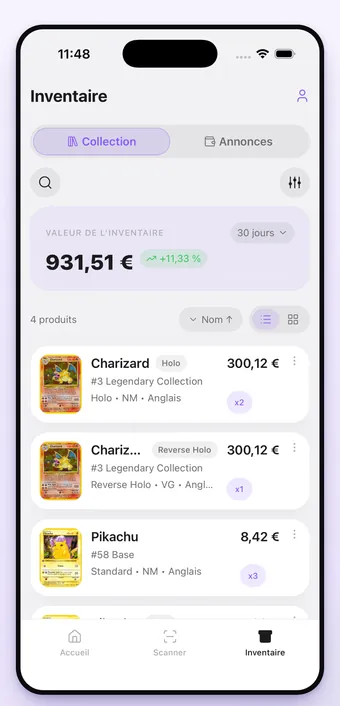
Pepita finds the set, number, language and finish from one photo, then shows sourced prices in euros. The app is available in English and French.
Frequently asked questions
How do I work out what my Pokémon card is worth from sold listings?
Collect at least three completed sales of the exact same card, set number, language, finish, condition and grade, then take the median. It shows the middle of real sales and is far less distorted by one odd sale than the mean.
Why show the median rather than the average?
One very high or very low sale moves the average a lot. The median shows the middle of the sample. Both are displayed so you can see how far apart they are.
Which sales can I put in the same group?
Only the same card, set, number, language, finish, edition, condition and grade. A PSA 9 never belongs with ungraded copies, and a Japanese print never belongs with an English one.
Does the result tell me what my card is worth?
No. It summarises the prices you entered. The sale date, the marketplace, fees, photos and demand can all change the price you actually get.
What does “possible outlier” mean?
The sale falls outside the usual bounds calculated with the interquartile range. Check the listing for a lot, included postage, a different variant, the condition or a typo. It is never removed automatically.
Should I use asking prices or sold prices?
Sold prices. An asking price is only what a seller hopes for. Use completed sales, for example from Cardmarket’s sales history or eBay’s sold-items filter, and note their dates.